Shakil Ahmed

I am a computer vision and deep learning researcher focused on images and video where labels are scarce and conditions are difficult. I have built models that detect objects in murky water, describe videos in natural language, and sort camera-trap images of hundreds of moth species with vision foundation models, taking each from raw data to a working tool.

Research Assistant, Aarhus University

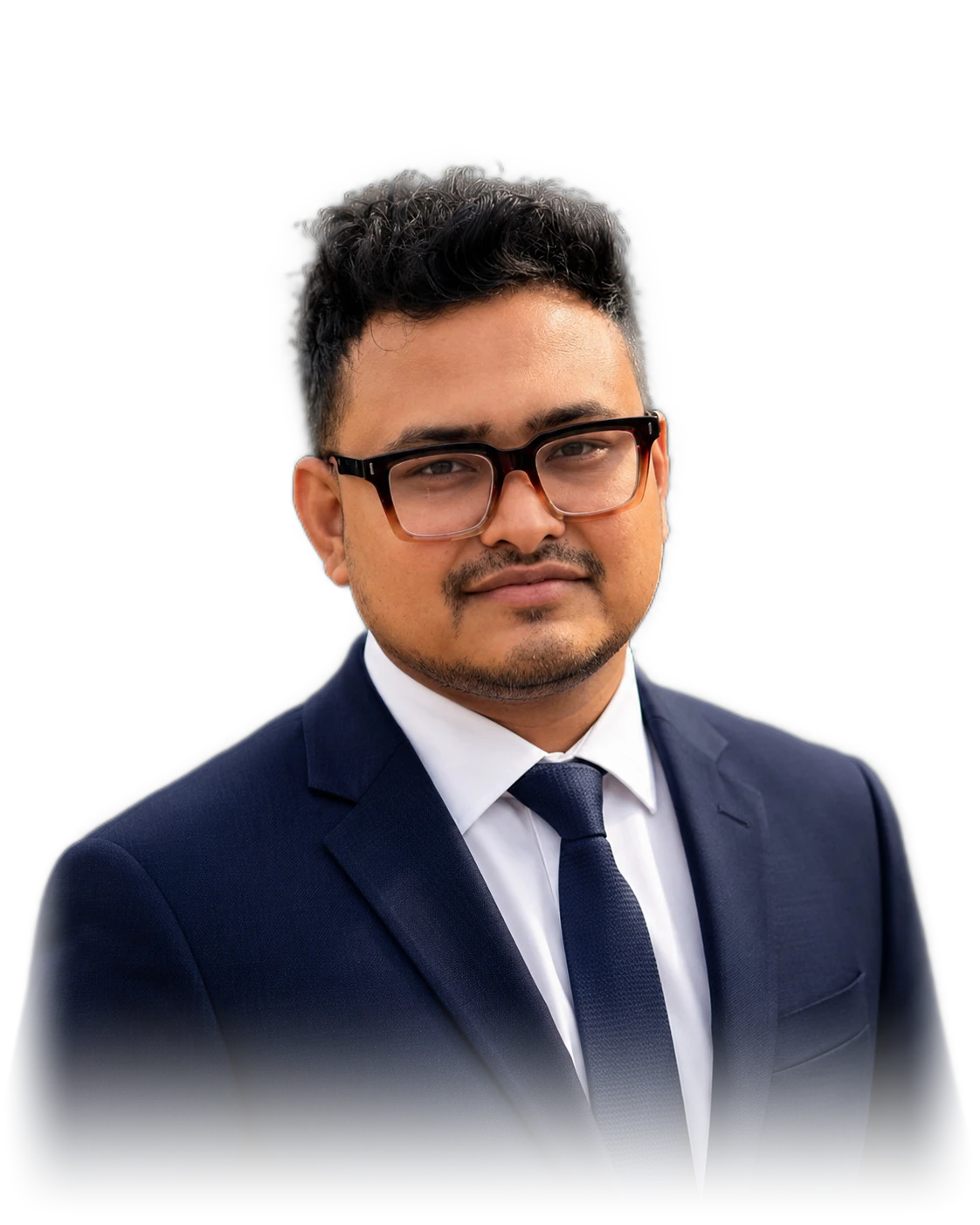
Portrait of Shakil Ahmed

Research

I have written three theses, and each asked a model to understand a little more from pixels. The first had to find an object in murky water. The second had to describe what happens in a video. The third has to organise thousands of insect photographs that no one has labelled.

2020 · BSc thesis, AIUB

Finding objects underwater

Under water, light scatters, colours fade towards blue and green, and bubbles and sediment hide whatever you are looking for. For my BSc thesis I recorded objects in clear, turbid and bubbling water, and studied how far colour-based detection and tracking can go there, using HSV segmentation in OpenCV.

ICETCE 2020, IEEE. With Md. Fazle Rabbi Khan, Md. Farhan Anjum Labib and AZM Ehtesham Chowdhury. Paper

2021 · MSc thesis, AIUB

Describing video in words

For my first master's I moved from objects to events. Att-BiL-SL watches a video and writes a sentence about it. Two attention-based Bi-LSTM layers encode how the frames change over time, a sequential LSTM decodes the sentence, and soft attention with beam search picks each word. It performed better than several existing captioning models.

I later rebuilt the idea for single images, pairing ResNet-101 with an attention LSTM, and reached a BLEU score of 58.5 on Flickr8k.

Applied Sciences, 2021. With A F M Saifuddin Saif, Md Imtiaz Hanif and colleagues. Paper

2024–2026 · MSc thesis, Aarhus University

Beyond the annotation bottleneck

Automated camera traps photograph insects far faster than anyone can identify them, so most of those images never get a label.

My thesis, supervised by Kim Bjerge and Christian Nørgaard Storm Pedersen, starts from vision foundation models such as BioCLIP 2, trained on more than 200 million images of living things. Their embeddings tend to place images of the same species close together, even without labels.

I cluster those embeddings without supervision, so that images of the same species end up in the same fine-grained group although none of them carries a label.

The foundation model then names each group zero-shot, so an expert checks a handful of named groups instead of thousands of single images. Alongside the work we released DK-Moth, a camera-trap dataset of 248 Danish moth species.

With Kim Bjerge, Flemming Helsing-Nielsen, Toke T. Høye and Christian N. S. Pedersen. DK-Moth on Zenodo

Publications

Listed from my ORCID record, with authors and citation counts from OpenAlex.

Co-authors

About

I studied computer science at American International University-Bangladesh in Dhaka, finishing a BSc in 2020 (Magna Cum Laude, three Dean's List awards) and an MSc in 2021 with a 4.00 CGPA (Summa Cum Laude). Both theses became papers.

Then I spent a few years building software. I taught Flutter in the ICT Division's mobile development programme, where I supervised 16 student projects, and joined IT Garage to ship Android and iOS apps for government projects.

In 2024 I came to Aarhus University for a second MSc in Computer Science. Next to the thesis I was a teaching assistant in Deep Learning for Visual Recognition, helping more than 50 students implement, tune and benchmark vision models in PyTorch, and in Computer Architecture, Networks and Operating Systems.

Since November 2026 I have been a research assistant in the Department of Electrical and Computer Engineering at Aarhus University, working with Kim Bjerge. We are testing BioCluster, the tool built from my thesis, and integrating it into other tasks.

I review for Neurocomputing, Image and Vision Computing, the Journal of King Saud University: Computer and Information Sciences, and the Journal of Medical Engineering and Technology. Most of my work is in Python and PyTorch, and I also program in C++, Dart and R.
Honours and peer review

Contact

I'm looking for a PhD position in computer vision and deep learning. If your group works on related problems, I would be glad to talk.

ahshakil.au@gmail.com